America/Chicago
Blog
January 22, 20268 min read

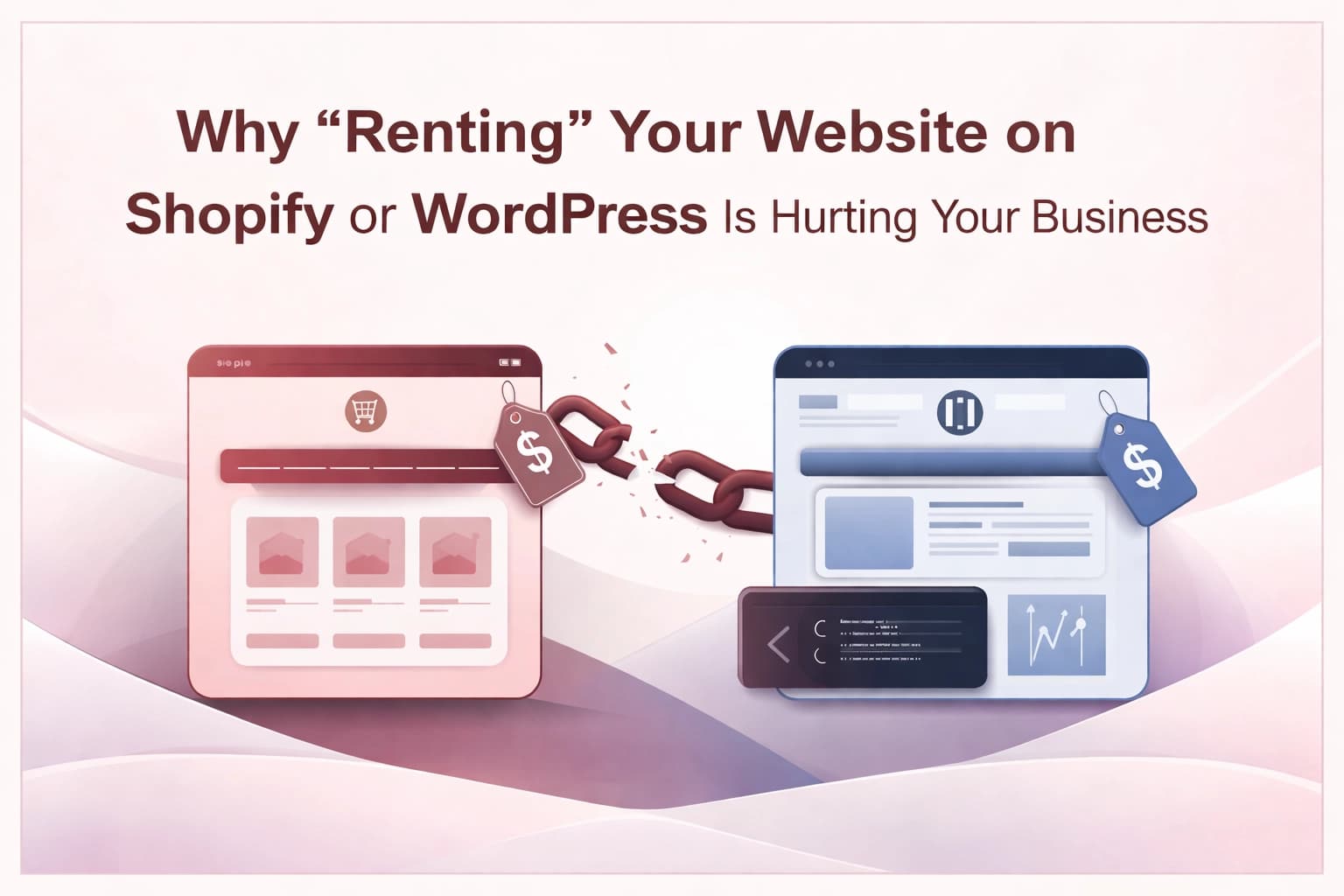
Why 'Renting' Your Website on Shopify or WordPress Is Hurting Your Business

Chris Ramirez
Platforms like Shopify and WordPress seem convenient, but the hidden costs, limited control, and transaction fees add up. Learn why custom web development is the smarter long-term investment for your business.
You wouldn't build your entire business on rented land. So why are you doing exactly that with your website? Every month, millions of business owners hand over $39, $79, or even $299 to platforms like Shopify and WordPress. They add plugins. They pay transaction fees. They work around limitations. And at the end of the day, they don't actually own the thing that runs their business. I get it. These platforms are easy to start with. But "easy to start" and "smart for the long haul" are two very different things. As a Lubbock web development specialist who builds custom solutions for businesses ready to take control, I've watched too many entrepreneurs realize this lesson the hard way. Let's break down why renting your website is costing you more than you think. Here's the pitch you heard: "Start your online store for just $39 a month!" Here's what they didn't tell you. Shopify's Basic plan starts at $39 per month. But that only covers the basics. Want email marketing? That's an extra $10 to $50 monthly. Need product bundling? Another app. Abandoned cart recovery with advanced features? You guessed it. More fees.
Visual of money and app subscription icons flowing into a funnel, symbolizing small business website platform fees draining profits
And then there are the transaction fees. Unless you exclusively use Shopify Payments, you're paying 2% on every single sale. For a business doing $10,000 a month, that's $200 gone before you even factor in credit card processing. Let's do some quick math:
  • Shopify plan: $79/month
  • Essential apps and plugins: $50/month
  • Transaction fees (2% on $10k): $200/month
  • Total: $329/month or nearly $4,000/year
Over five years? You've spent $20,000 and you still don't own your platform. Compare that to a custom ecommerce website development project. Yes, there's an upfront investment. But once it's built, it's yours. No monthly platform fees. No transaction cuts. No surprise price hikes when Shopify decides to "update their pricing structure." Every business is unique. Your website should reflect that. But rented platforms don't see it that way. They see you as one of millions of tenants who need to fit into their pre-built boxes. Shopify's structure prevents deep customization of core functionality. Want to change how your checkout works? Too bad. Need a custom feature that doesn't exist in their app store? Build it somewhere else. I recently talked to a furniture company owner who wanted to add a room visualization tool to their Shopify store. Customers could upload a photo of their room and see how different furniture pieces would look. Great idea, right? Shopify said no. The platform simply couldn't support it. They switched to a custom-built solution on WordPress, self-hosted WordPress, not WordPress.com, and created exactly what they envisioned. The result? Bounce rates dropped. Engagement went up. Average order value increased by 20%. That's what happens when you own your platform. You build what your business needs, not what a platform allows. Search engine optimization isn't just about keywords. It's about technical control. Rented platforms give you basic SEO features. You can edit title tags. You can write meta descriptions. You can add alt text to images. But that's surface-level stuff.
Side-by-side comparison of a slow, plugin-heavy website versus a fast, custom Lubbock web development site
Real SEO requires deeper access. Custom schema markup. Full control over URL structures. Core Web Vitals optimization. Server-side rendering for faster load times. Advanced caching strategies. Shopify imposes rigid URL structures you can't change. WordPress.com limits what plugins you can install. Both platforms restrict the technical optimizations that actually move the needle in competitive search results. If you're a Lubbock business trying to rank for local searches, these limitations matter. When your competitor has a lightning-fast custom site with perfect technical SEO and you're stuck on a bloated Shopify theme with 47 apps slowing everything down, guess who Google favors? This isn't hypothetical. 4Kingdom, a custom platform I built, scores a perfect 100 on SEO audits and loads in under 2 seconds—while running with zero platform fees and zero transaction cuts. That's what's possible when you're not fighting against your platform's limitations. This is the part that keeps me up at night for business owners who don't realize it yet. When you build on Shopify, Wix, Squarespace, or WordPress.com, you don't own your platform. You're renting space on someone else's property. And the landlord makes all the rules. They decide which features you can use. They decide how much you pay. They decide what's acceptable on their platform. And here's the scary part: they can change any of it at any time. Platform dependency is real, and it shows up in the little rules you don't notice until you hit a wall. Your checkout options, your payment flow, which apps you're allowed to run, how you collect customer data, even what you can sell—it all sits under someone else's terms of service. And those terms can change. Sometimes it's pricing. Sometimes it's what features are available on your plan. Sometimes it's policy changes that force you to rework your entire setup fast. That's not ownership. That's risk. So what's the solution? Custom web development using modern technologies like React and Node.js.
A glowing key unlocking a digital platform, representing the benefits of owning your custom ecommerce website
When I build a custom ecommerce website for a client, here's what they get:
  • Full ownership. The code is yours. The data is yours. No one can lock you out.
  • Scalability without penalties. Grow your traffic and sales without your platform taking a bigger cut or forcing an upgrade.
  • Zero platform fees. Keep your margins. No monthly rental fees eating into your profits.
  • Unlimited customization. Need a feature that doesn't exist in an app store? We build it. If you can dream it, we can make it work.
  • Better performance. Custom sites built with React are fast. Really fast. That means better user experience and better SEO.
Let's address this directly. Yes, custom development has a higher upfront cost than signing up for Shopify. That's true. But let's think about this differently. If you're planning to run your business for the next five to ten years, which makes more financial sense? Paying $20,000 to $40,000 in platform fees, transaction cuts, and premium apps over that time? Or investing in a custom platform you own outright? Custom development isn't an expense. It's an asset. One that appreciates as your business grows instead of draining your revenue month after month. For serious business owners in Lubbock and across West Texas, this is the move that separates the businesses that plateau from the ones that scale. Custom development isn't for everyone. If you're brand new and testing a product idea, Shopify makes sense. Get your proof of concept, validate demand, then revisit the platform question once you've outgrown it. But if you're past that stage, here's how to know if custom development is worth exploring:
  • You're spending $200+ per month on platform fees and apps. That money compounds. Over five years, you've spent enough to fund a custom build and then some.
  • You keep hitting walls. You want to change something about your checkout, your product pages, or your customer flow—and the platform says no.
  • You need real integrations. Your warehouse system, CRM, or fulfillment center requires workarounds and duct tape to connect. Custom development lets you build those connections properly.
  • You're planning to scale. Platforms take bigger cuts as you grow. Custom sites don't penalize your success.
  • You want to own what you're building. Not rent it. Not hope the terms of service don't change. Actually own it.
If you checked two or three of those boxes, it's worth a conversation. Shopify and WordPress aren't evil. They serve a purpose for people just getting started or testing an idea. But if you're past that stage—if you're building something real—you need to own your platform. Stop paying rent. Stop working around limitations. Stop handing over transaction fees and hoping the platform doesn't change the rules on you. Take control. If you're ready to explore what custom web development looks like for your business, I'd love to chat. I'm a solo developer based in Lubbock, TX, and I specialize in building platforms that businesses actually own. No templates. No monthly fees. Just clean, fast, custom code built around your specific needs. Check out my work at theacrdeveloper.com and let's build something you own.
Share this post: